
Vasyl Mykhailovych Ivanchuk, born on March 18, 1969, in Kopychyntsi, Ukrainian SSR, Soviet Union, stands as one of the most talented, creative, and enduring figures in modern chess history. A Grandmaster since 1988, he has never won the classical World Championship but has been ranked world No. 2 three times (July 1991, July 1992, and October 2007), reached a peak FIDE rating of 2787, and claimed victories in elite tournaments while defeating every World Champion from Anatoly Karpov to Magnus Carlsen. His career, spanning over four decades, is defined by brilliant creativity, emotional intensity, unpredictable style, and remarkable longevity.
Early Life and First Steps
Ivanchuk grew up in a modest family in western Ukraine. His father worked as a lawyer, and his mother taught physics. Chess entered his life through a simple gift: a magnetic chess set from his father. His first book, Journey to the Chess Kingdom by Yuri Averbakh and Mikhail Beilin, sparked a passion that would define his existence.
By the mid-1980s, young Ivanchuk showed extraordinary promise. In 1985, he won the USSR Junior Chess Championship and earned bronze in the Ukrainian Championship. The following year, he enrolled in the chess faculty of the Lviv State University of Physical Culture, dedicating himself fully to the game.
His international breakthrough came quickly. He won the 1986/87 European Junior Chess Championship in Groningen. In 1988, as an International Master, he dominated the New York Open with 7½/9, ahead of numerous grandmasters. That same year, he tied for first in the World Junior Championship in Adelaide but lost the title on tiebreaks to Joël Lautier. FIDE awarded him the Grandmaster title in 1988, and he entered the world top 10 shortly thereafter.
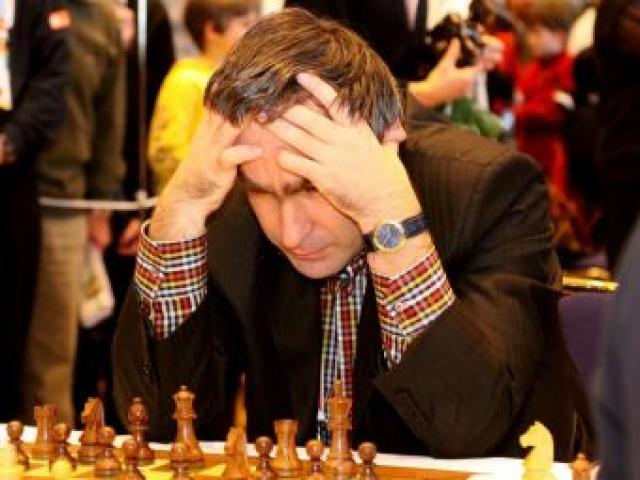
These early successes marked Ivanchuk as a rising star from the Soviet chess powerhouse, transitioning seamlessly into the elite as the Soviet Union dissolved.
Rise to the World Elite (1989–1995)
Ivanchuk's ascent accelerated in the late 1980s and early 1990s. He won Linares in 1989, a prestigious event. His 1991 Linares victory catapulted him to global fame. At age 21, he triumphed in a super-tournament featuring eight of the world's top 10 players, including reigning champion Garry Kasparov. Ivanchuk finished half a point ahead of Kasparov and defeated him head-to-head in a memorable game where he sacrificed both bishops for knights, restricting Kasparov into passivity.
This performance propelled him to world No. 2. Many viewed him as a future world champion. He repeated Linares success in 1995 and added wins in events like Wijk aan Zee (1996), Biel, Tilburg, and others. His rating climbed, and he consistently ranked among the top players.
Ivanchuk represented the Soviet Union in the 1988 and 1990 Chess Olympiads, contributing to gold medals. After Ukraine's independence, he became the cornerstone of the Ukrainian team, playing board 1 in most events.

His style—deep calculation, imaginative sacrifices, and a vast opening repertoire—impressed peers. He played almost any opening with equal skill, often choosing rare or surprising lines to unsettle opponents.
World Championship Challenges and Near Misses
Despite his talent, Ivanchuk never claimed the classical world title, a source of lasting regret and discussion. The 1993 split between FIDE and Classical titles complicated cycles. He reached the final of the 2002 FIDE World Championship in Moscow but lost to compatriot Ruslan Ponomariov in a major upset, despite being the favorite after defeating Viswanathan Anand in the semifinals.
Observers often attributed his misses to temperament and nerves under pressure. Famous incidents include a 1994 blitz game against Anand where he missed a mate in one with significant time left, and emotional outbursts, such as sweeping pieces off the board or, after a crucial loss in the 2008 Olympiad, kicking a concrete pillar in distress.
Ivanchuk participated in multiple Candidates and World Cup events but frequently underperformed in knockout formats. In the 2013 Candidates Tournament in London, he finished seventh but delivered key wins over Magnus Carlsen and Vladimir Kramnik, influencing Carlsen's qualification. His poor time management, including time forfeits, highlighted ongoing struggles.

The chess world widely regards him as one of the greatest never to become world champion, comparable in talent to legends like Akiba Rubinstein or Viktor Korchnoi.
Peak and Continued Dominance (2000s–2010s)
Ivanchuk's second peak came around 2007. He reached world No. 2 again with a 2787 rating in October 2007. That year, he won the World Blitz Championship. In 2016, at age 47, he claimed the World Rapid Championship in Doha with 11/15, defeating Carlsen and others.
He amassed victories in elite events: multiple Linares, Tal Memorial (2008), M-Tel Masters Sofia (2008), Gibraltar Masters (2011, with 9/10), Capablanca Memorial (several times), and more. He won or shared first in events like Bazna, Jermuk, and the Grand Slam.
On the team front, Ivanchuk shone in Olympiads. He earned 13 medals across 14 appearances (two for USSR, twelve for Ukraine), including four team golds (1988, 1990, 2004, 2010). His individual highlights include board gold in 2010 (8/10) and strong performances like 9½/13 in 2004. Overall, he scored +63 =87 -12 in Olympiad play.

He remained competitive into his 50s, winning the Menorca Open in 2025 with 8/9 and staying in the top 100. As of May 2026, his rating stands around 2634, still formidable.
Playing Style and Creativity
Ivanchuk's chess is celebrated for creativity, imbalance, and deep originality. He fuses technical precision with imaginative play, often sacrificing material for initiative or positional pressure that defies standard principles. His universal style allows mastery of sharp tactical battles and subtle endgames alike.
Commentators describe his games as rich in ideas, with unexpected sacrifices and profound calculations. He has a vast repertoire, playing everything from main lines to sidelines. Kasparov, Anand, Polgár, and others have praised his genius; Kasparov once placed him in the category of world champions.
Famous games include his 1991 win over Kasparov, crushing victories against Topalov, Shirov, and many others. His ability to "box in" opponents or create chaos on the board remains unmatched.

Personality and Personal Life
Ivanchuk is known as eccentric, moody, and emotional—"Planet Ivanchuk," as Anand described it. He can be warm one day and distant the next. He loves Ukrainian poetry, has been seen singing while intoxicated, and delivers insightful talks. Losses affect him deeply, yet his love for chess endures.
He married Russian WGM Alisa Galliamova in 1991 (divorced 1996). In 2006, he married Oksana. The couple faced a mugging incident in 2011 in Brazil but continued competing. Ivanchuk has received Ukrainian honors, including the Order of Merit (1st class) and Order of Prince Yaroslav the Wise.
Beyond chess, he took up checkers in 2016, achieving a peak rating of 1997. His curiosity extends to various intellectual pursuits.
Legacy and Impact

Ivanchuk's career earnings exceed $1 million, but his true legacy lies in inspiration. He has played thousands of games at the highest level, influencing generations with creative ideas. At an age when many retire, he continues competing and winning opens, embodying passion for the game.
His Olympiad contributions strengthened Ukrainian chess. Young players study his games for creativity and fighting spirit. Despite never becoming classical world champion, his rapid and blitz titles, super-tournament wins, and No. 2 rankings cement his place among all-time greats.
Ivanchuk once said something to the effect that setting goals whose achievement is not fully in one's hands may not be worthwhile. Yet, through decades of ups and downs—Soviet era to independent Ukraine, pre- and post-computer chess—he has pursued chess on his terms, with unmatched authenticity.
In an era of engines and precise preparation, Ivanchuk reminds us of chess as art: human, flawed, brilliant, and deeply emotional. His games will be studied for generations, his personality legendary, and his contributions to Ukrainian and world chess immeasurable.